The Covid-19 pandemic has hit Poland in a difficult period. The issue of postponing the presidential election, originally scheduled for 10 May, has led to significant tensions in an already deeply polarised political scene. While decision-makers were quick to introduce restrictive measures, they have questioned the efficacy of the solutions to the Covid-19 crisis proposed by the EU. However, in spite of the political rhetoric of self-sufficiency, Poland needs greater EU solidarity, especially when it comes to economic challenges.
Beyond its immediate effects as a global health crisis, the Covid-19 pandemic poses manifold political and economic challenges for the EU and its member states. Previous crises have shown that the EU's crisis management is dominated by intergovernmentalism and often limited to damage control. Nevertheless, common institutions and procedures such as those of the eurozone offer clear added value for the limited capacities of each member state and will make a difference in the long run.
Anfang Februar 2020 besuchte der französische Präsident Emmanuel Macron zum ersten Mal in seiner Amtszeit Polen. Der Besuch war auch eine Reaktion auf eine deutliche Verschlechterung der Beziehungen zwischen Paris und Warschau in den vergangenen Jahren und stark vom Bemühen geprägt, für neue Dynamik im bilateralen Verhältnis zwischen den beiden Staaten zu sorgen. Im Lichte von Macrons Polen-Besuch werfen Jérôme Heurtaux, Elsa Tulmets und Pawel Zerka einen umfassenden Blick auf den aktuellen Stand des oft als schwächste Seite des Weimarer Dreiecks beschriebenen französisch-polnischen Verhältnisses und machen einige konkrete Vorschläge, wie diese Beziehungen revitalisiert werden könnten.
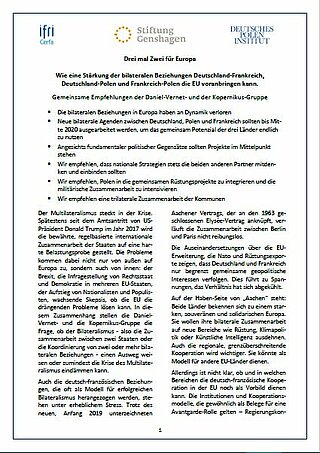
„Drei mal Zwei für Europa: Wie eine Stärkung der bilateralen Beziehungen Deutschland-Frankreich, Deutschland-Polen und Frankreich-Polen die EU voranbringen kann.“
Seit 2008 organisieren die Stiftung Genshagen und die Friedrich-Ebert-Stiftung gemeinsam ein Format für junge außenpolitische Experten aus Frankreich, Deutschland und Polen, die "Weimar Young Perspectives (WYP)". In der 11. Ausgabe des Formats, die vom 21. bis 23. November 2018 in Berlin und Genshagen stattfand, befasste sich die Gruppe mit den neuesten Entwicklungen auf der globalen strategischen Bühne und insbesondere mit dem Handlungsspielraum, über den Europa angesichts dieser Entwicklungen verfügt. Das vorliegende Genshagener Papier stellt in einer Essaysammlung die Einschätzungen von drei dieser jungen Experten zur aktuellen globalen Rolle Europas vor.
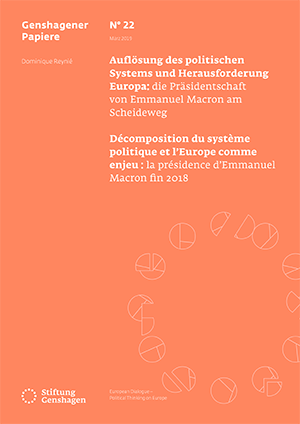
Dieser Aufsatz des renommierten Politikwissenschaftlers Dominique Reynié ist ein Beitrag zur Analyse der Situation Frankreichs anderthalb Jahre nach der Wahl von Emmanuel Macron zum Präsidenten der Republik unter beispiellosen und unvorhersehbaren Bedingungen. Dieses im wahrsten Sinne außergewöhnliche Ereignis ist die Folge der politischen Krise in Frankreich, das Ergebnis alter Blockaden, die die französische Gesellschaft allmählich gelähmt haben, und die die aufeinanderfolgenden Mehrheiten nicht aufzuheben wussten, konnten oder wollten.